Freight Car
Double-stack well car
Athearn
Photographs (2)
Technical specifications
History
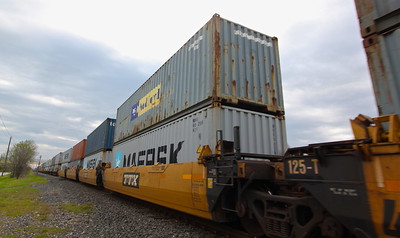
The double-stack well car traces its origins to a collaborative effort between Southern Pacific Railroad and Sea-Land Service in 1977, when the two organizations began exploring ways to increase the efficiency of intermodal freight movement by rail. That same year, Southern Pacific partnered with ACF Industries to produce the first purpose-built car embodying the concept. The design placed a depressed center section, or well, between the wheel trucks so that the lower of two stacked containers would ride closer to the rail, allowing a second container to be loaded on top while still maintaining acceptable clearances through tunnels, bridges, and other fixed structures. Although the concept was sound from the outset, adoption across the broader industry was gradual through the late 1970s and early 1980s. The technology gained decisive commercial momentum in 1984, when American President Lines joined with the Thrall Car Manufacturing Company to develop a more refined well car design and subsequently partnered with Union Pacific to inaugurate dedicated double-stack train service. That year saw the departure of the first all-double-stack train from Los Angeles bound for South Kearny, New Jersey, operating under the name Stacktrain. The consist transferred between several carriers along its route, passing from Union Pacific to Chicago and North Western and then to Conrail for the final leg eastward. The demonstrated efficiency of this service, which effectively doubled the container-carrying capacity of a given train length without a proportional increase in locomotive power or crew requirements, convinced major railroads and intermodal operators to invest heavily in the equipment. By the late 1980s and through the 1990s, double-stack well cars had become the dominant equipment type for intermodal container service across North American Class I railroads. Fleet management was eventually consolidated significantly under TTX Company, which maintained a large pool of well cars available to member railroads. The design spread internationally as well, with well cars operating in Australia on routes between Perth, Adelaide, and other major terminals, and manufacturers such as CRRC producing variants for markets in China and Kenya. Infrastructure improvements in the United States, including the Heartland Corridor project undertaken by Norfolk Southern and the National Gateway initiative by CSX Transportation, involved raising or eliminating clearance restrictions specifically to permit double-stack operations over more of the national network.
Technical notes
Double-stack well cars assigned the AAR code SD are intermodal equipment built to accommodate shipping containers in wells measuring most commonly 40, 48, or 53 feet in length, with some cars featuring 45-foot or 56-foot wells. The rated capacity is typically 80 tons per well for single-unit cars, while articulated multi-unit cars generally carry approximately 120,000 pounds per well. The cars are most frequently assembled into articulated three-unit or five-unit sets, with intermediate units sharing single trucks rated at 125 short tons and, in some configurations, 150 short tons. Units within a set are designated alphabetically, with end units carrying the A and B designations and interior units labeled C through E depending on the total number of units in the consist. Drawbar-connected sets of single-well cars sharing a single reporting mark represent an alternative configuration employed by a number of roads. Principal builders in North America have included Gunderson, Trinity Industries, and Thrall, with TTX Company serving as a major owner and pool operator. A notable design variant is the Econo Stack or Twin Stack car, a Gunderson product featuring fixed bulkheads at each end of the well rather than relying solely on inter-box connectors to secure stacked containers. While the bulkheads provide additional structural support for the stack, they limit the length of containers that can be placed in the upper position to 45 feet, excluding the 53-foot containers that have become increasingly prevalent in domestic intermodal service. The added structural material also increases the tare weight of bulkhead-equipped cars compared to conventional well cars, a disadvantage that has made them less popular with railroads seeking to maximize net payload per train. Containers are secured between stacking positions using four inter-box connectors per well on standard cars, and some well cars have been fitted with trailer hitches at each end to permit the carriage of semi-trailers in addition to ISO containers, a configuration marketed as the all-purpose well car.
Operating railroads
—
Model manufacturers
Models by: Athearn · Atlas · Kato · ScaleTrains
Shop Double-stack well car HO Scale Models (5)
 Kato
Kato Athearn
 ScaleTrains
Frequently Asked Questions
What is the Double-stack well car?
The double-stack well car traces its origins to a collaborative effort between Southern Pacific Railroad and Sea-Land Service in 1977, when the two organizations began exploring ways to increase th...
Who makes Double-stack well car in HO scale?
4 manufacturers produce the Double-stack well car in HO scale: Athearn, Atlas, Kato, ScaleTrains.
How many HO scale Double-stack well car models are available?
There are 5 HO scale Double-stack well car models tracked on TrainDex.